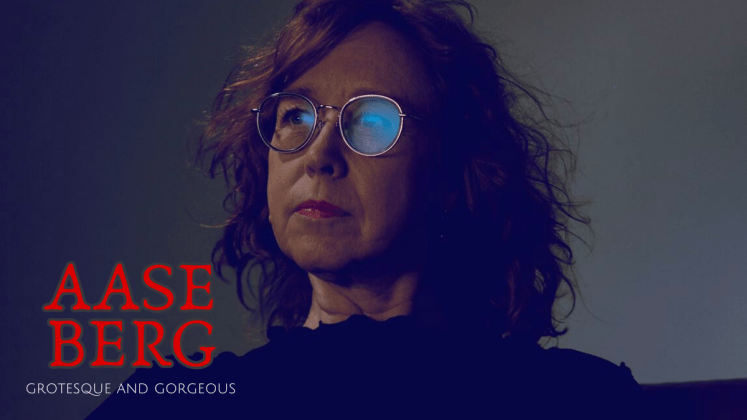
July and August ended up being shaped by one poet: Aase Berg. I didn’t plan it, but sometimes reading takes on its own rhythm. Over those months I worked through four of her collections, and what follows are some loose, half-formed thoughts—more like reading notes than proper reviews.
One day I’d love to write a more careful, well-researched piece on Berg and her impressive body of work, but that’s not what today is. This post is about the experience of reading her poems in close succession. Still, for anyone who hasn’t come across her before, a quick introduction: Berg is a contemporary Swedish poet known for grotesque, haunting work written in a distinctly Surrealist style.
The four collections I read, in order, were Ouroboros, With Deer, Dark Matter and Transfer Fat. What struck me most about this particular group was their publication years. With Deer, Dark Matter and Transfer Fat appeared in 1997, 1999 and 2002 respectively, while Ouroboros came more than a decade later, in 2013. I think the order in which we encounter a writer matters a lot—it shapes how we connect (or don’t connect) with their work. I only started with Ouroboros because it was the one my university library had on hand. From there, going back to her earlier collections and hearing the same themes reverberate ten or more years earlier was a special kind of reading experience.
(Dates are for the original Swedish editions, not Johannes Göransson’s English translations.)
Of the four, With Deer was my favourite. I tend to measure how much I enjoy a poetry collection by how often I highlight or take photos of lines—sometimes whole poems. I highlighted a lot here. It felt the richest in imagery and themes, full of both beautiful and grotesque lines that carried me away.
Dark Matter deserves a mention too. To me, it had the most obvious narrative thread: a world where science, pseudoscience and science fiction collide with Berg’s recurring concerns about the body and identity. As in all four books, she blurs the boundary between human and nonhuman until it’s unclear where one ends and the other begins.
Berg isn’t a poet for everyone, certainly not for the weak-stomached. But if you’re drawn to horror, the grotesque, and the kind of haunting lines that echo long after you’ve read them, she might be exactly what you’re looking for.
 Earl Grey Books